

Landmines and Leadership: The Case for a Values‑Driven Economic and Security Policy
How humanitarian demining allows Canada to align its economic interests, security priorities, and commitment to the Ottawa Treaty in a rapidly shifting global order.
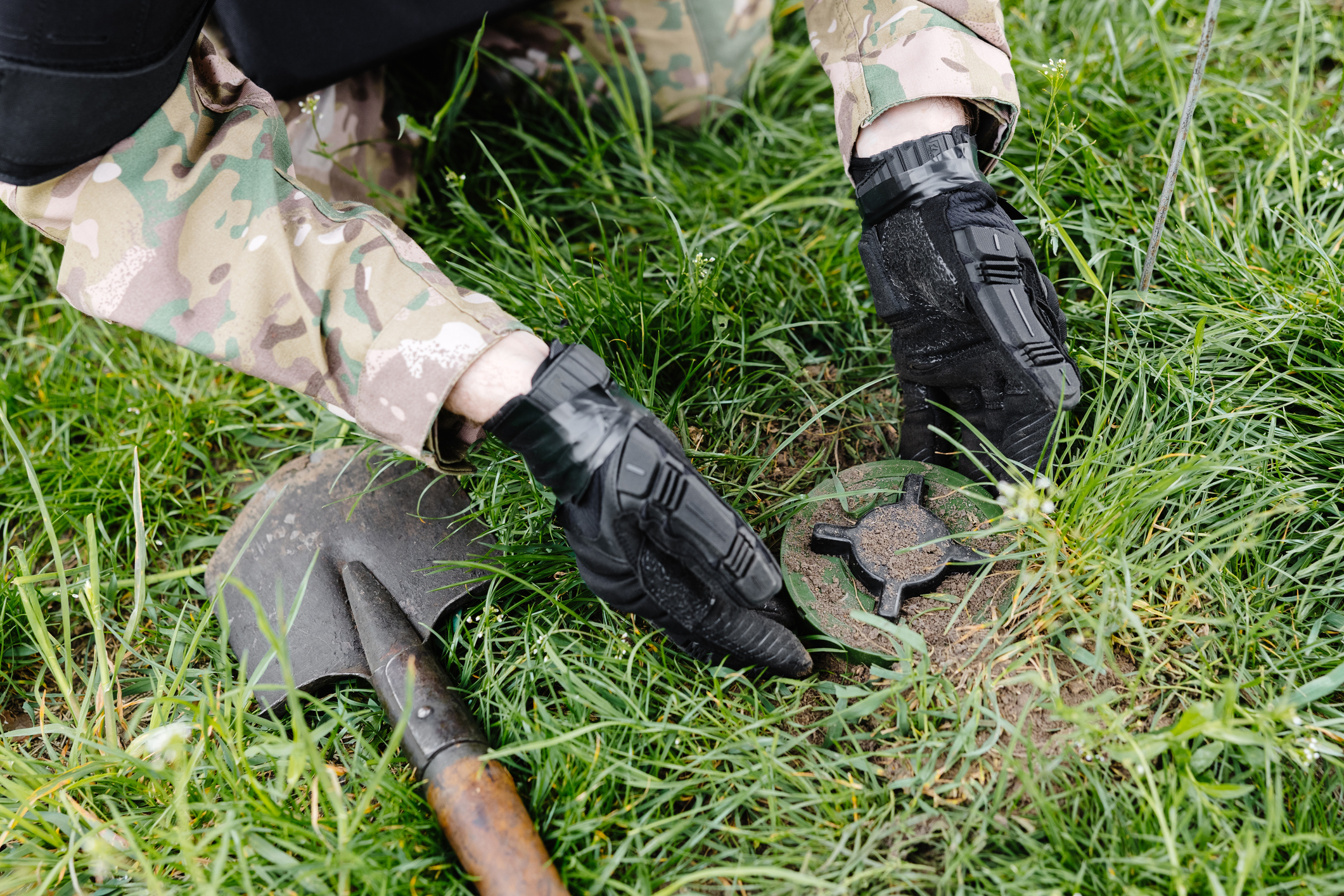 Military offical works to demine local forrest, helping ensure the saftey of the local population.


In Davos, this year, at the World Economic Forum, Mark Carney stood on stage declaring to the world that intermediate powers such as Canada are not powerless. On the contrary, he argued, they have “the capacity to build a new order that encompasses our values, such as respect for human rights, sustainable development, solidarity, sovereignty, and the territorial integrity of states.”
This also presents a new opportunity for Canada to lead on the issue of landmines. From Lester B. Pearson’s role in advancing UN peacekeeping during the Suez Crisis to Canada’s role in helping protect U.S. diplomats during the 1979–80 Iran hostage crisis, Canada has at times translated principle into practical action.
That tradition still offers something worth drawing on.
Humanitarian demining offers Canada a practical way to align its economic interests, security priorities, and diplomatic leadership.
As a leading champion of the Ottawa Treaty, which bans the use, stockpiling, production, and transfer of anti-personnel mines, Canada helped advance one of the most significant humanitarian disarmament agreements of the modern era. That legacy reflects a broader tradition of linking diplomatic leadership to humanitarian action. To this day, the treaty remains a rare and remarkable achievement in global disarmament.
Landmines: Impact Beyond Borders
The connection between mine action, economic resilience, and security is not abstract. Its effects can be seen in how landmines disrupt livelihoods, weaken recovery, drive displacement, and generate economic shocks that extend well beyond the countries directly affected.
Landmines harm indiscriminately. In 2024, 6,279 people were killed or injured by landmines and 90 percent of the victims were not soldiers or armed combatants, but civilians, half of them children. Behind these numbers lie shattered families, streets and neighborhoods haunted by hidden killers, and lives forever changed in an instant. The effects extend outward, undermining livelihoods, disrupting recovery, and destabilizing communities long after conflict has receded.
Landmines paralyze national economies by contaminating farmland and disrupting transport networks, targeting economic assets, creating unsafe conditions for workers, undermining food security and livelihoods and ultimately, generating global market instability that affects countries around the world, including Canada.
In Ukraine, landmines are estimated to contaminate 23 percent of the country (139,000 km²), contributing to a 41 percent drop in wheat production between 2021 and 2024 and imposing economic losses estimated at $11.2 billion annually, or 5.6 percent of pre-war GDP. The consequences extend beyond Ukraine. As exports from one of the world’s major grain producers have been constrained, supply disruptions and price pressures have rippled through global markets, affecting food security, trade, and investment far beyond the region. For Canada, these disruptions matter not only through higher costs and market volatility, but because land contamination can limit reliable access to markets, suppliers, and economic partnerships in conflict-affected regions.
Impact from landmines is not only felt at the macroeconomic level but also at the microeconomic level, reducing the workforce through injury and displacement. Those injured are unable to work during recovery, reducing available manpower and weakening the economy. A study found that 61 percent of landmine survivors in Cambodia, and 84 percent in Afghanistan, went into debt to cover medical costs, further reducing household spending and eroding economic activity.
Additionally, landmines contribute to large-scale displacement, preventing refugees from safely returning to their home countries. This drains the labor pool that local economies depend on and hinders economic reconstruction and growth. During the Assad regime, over 12.3 million people were displaced within Syria and across neighboring countries after more than 13 years of conflict.
Today, many of these displaced populations remain unable to return to their homes in Syria due to the persistent threat of landmines, further straining the economies of their home countries.
Demining: From Safer Ground to Stronger Economies and Partnerships
Landmines pose a threat that extends for decades after the conflict ends. Croatia declared in 2026 that it is finally landmine free, marking the end of a three-decade clearance campaign. Croatia’s thirty-year clearance effort illustrates the persistent economic drag caused by landmines. But as international evidence shows, humanitarian demining is uniquely positioned to convert post-conflict environments into engines of recovery and growth.
In Colombia, for example, humanitarian demining projects, unlike military demining, which provides little economic return because it is limited to tactical operations rather than full land clearance, can boost municipal GDP by 0.8 percent, with each dollar spent generating roughly $7 in returns within a single year.
The study also shows broader socio-economic benefits, school enrollment rises, student-to-teacher ratios improve, and student math and reading scores climb by 6.7–8.1 percentage points. These educational gains, in turn, build job skills, enabling individuals to access better employment, earn higher incomes, and contribute more effectively to long-term economic growth.
Another concrete example of the positive economic impact of humanitarian demining can be seen in Bissine, Senegal, once known as the “granary of Senegal”, before being abandoned due to conflict and landmines. Today, Humanity & Inclusion demining operations there cleared nearly 95,000 m² of land, allowing families to return after 30 years. The village, now home to about 375 residents, has resumed farming and reopened its school, which has grown from 29 to 130 pupils, marking the first steps in revitalizing both the community and its economy.
Humanitarian demining not only restores safety and livelihoods in affected communities but also creates tangible opportunities for Canada. Safer, more stable regions reduce operational costs for Canadian companies abroad, improve access to resources and partnerships, and foster trade with communities that trust those who have supported their recovery.
Canada’s Role
If Canada treats mine action as part of its economic and security strategy, not only as humanitarian assistance, it changes how and where it invests, partners, and leads. Canada’s vision of a world in which middle powers unite to counter hegemony can still be realized. With five countries leaving the Ottawa Treaty in 2025, the Carney government has an opportunity to reaffirm Canada’s leadership in humanitarian mine action while advancing both its principles and strategic interests. In 2024, Canada contributed $37.9 million to mine action projects, a 31 percent decline from $54.9 million in 2023. Reversing that decline by restoring funding to C$50 million annually would be a practical first step.
But leadership requires more than funding. Canada should also actively champion the Ottawa Treaty and press other states to uphold their commitments to protect civilians from landmines. Doing so would strengthen Canada’s diplomatic influence, reinforce international security, and position Canada as a reliable partner at a moment when humanitarian norms are under strain.
This is where Carney’s values-based pragmatism finds concrete expression. If that framework means aligning solidarity, human rights, and territorial integrity with strategic interests, mine action is a near-perfect example of how to operationalize that alignment. Demining reduces civilian harm, restores land to productive use, strengthens food systems and supply chains, and helps vulnerable states regain economic autonomy and territorial control. In turn, safer and more stable environments support trade, investment, and economic engagement that can also benefit Canada.
Far from a purely humanitarian exercise, mine action is a form of strategic statecraft. It advances human security, contributes to long-term growth and resilience, and supports the kind of geopolitical stability that middle powers can help sustain. In that sense, values-based realism shifts from rhetoric to strategy.
By leading through humanitarian demining, Canada can demonstrate that principled leadership, economic opportunity, and security are not competing objectives, but mutually reinforcing ones. Canada does not need to choose between values and interests here. Demining is one of the few areas where it can advance both, deliberately.
