

Turning Hate into Empathy
How the Israeli Palestinian conflict has impacted the Canadian Jewish and Muslim communities.
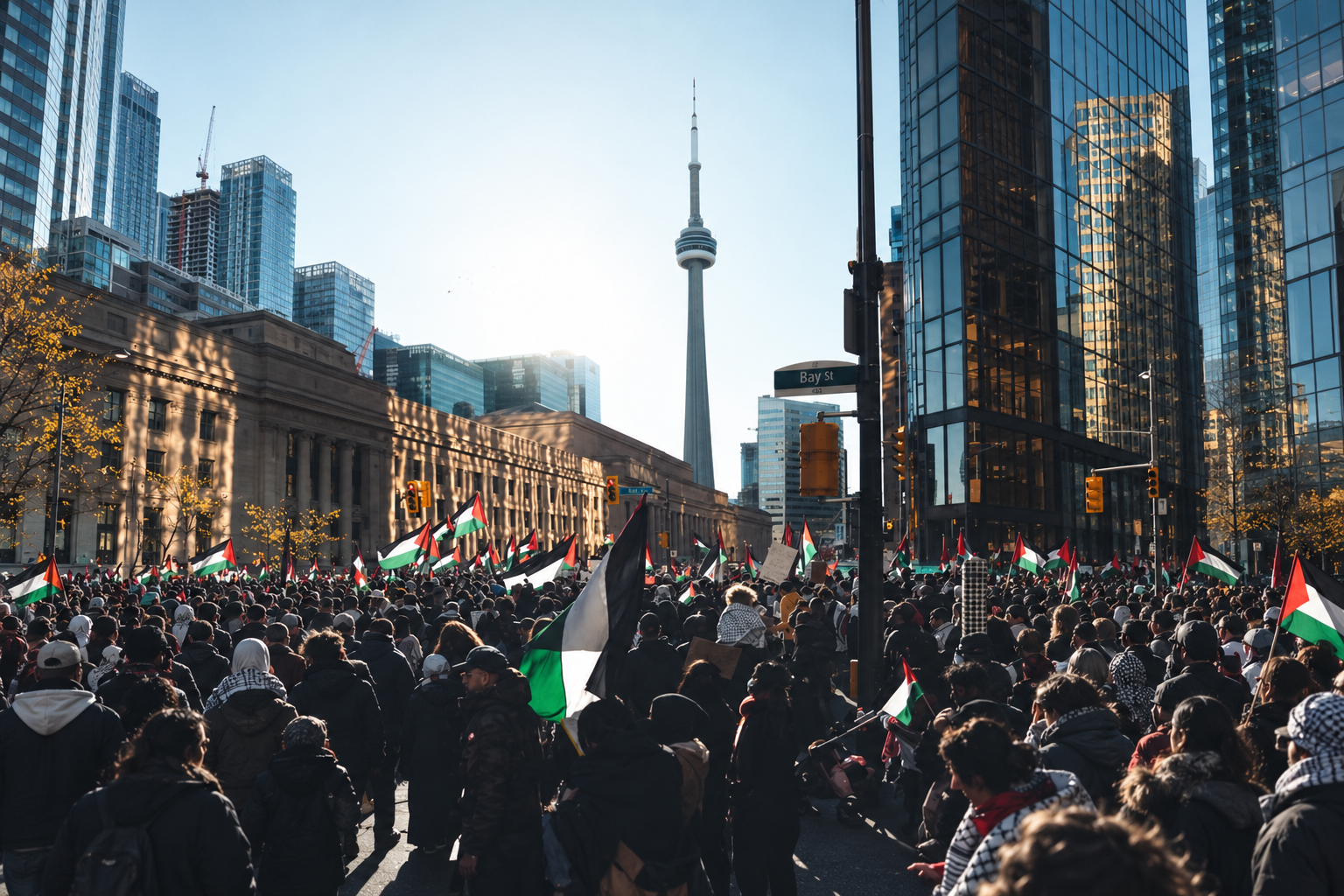 A pro-Palestinian rally in Toronto reflects the conflict’s impact on Canadian public life and the challenge of empathy between Jewish and Muslim communities.

Following Oct. 7, 2023, and Hamas’ horrific attack on southern Israel and the brutal response by the Israeli Defense Forces in Gaza that followed, it became evident that many Canadian Jews and Muslims alike found it difficult to feel empathy for the many thousands of dead and injured innocent Palestinians, on the one hand, and for the families of the dead and injured Israelis and the hostages that were being held, on the other.
Understanding the Israeli Palestinian conflict and its antecedents is complicated, but recognizing the death and destruction that it has produced on both sides shouldn’t have been. It is a sad testament to Canada’s strong multicultural traditions and previous examples where Jews, Christian and Muslims grieved with each other, that many mainstream Jewish and Muslim organizations, including clergy, were, for the most part, silent in the face of atrocities that occurred on both sides at the time.
It was equally concerning to have observed the hate, the extremism, the anti-Semitism and the anti-Palestinian racism that was generated by so many, especially university educated young people, many of whom didn’t seem to understand that this is a complex and longstanding conflict and that there is blame and responsibility on both sides.
Two Camps, Two Sets of Absolutes
On the one hand, protesters screamed genocide; demanded a Palestine from the river to the sea and claimed that Jewish Israelis are all colonials who have no original ties to the land. They suggested that Israelis should return to Europe from whence they came. (Given the horrors of the Holocaust, these were chilling cries for many Jews.) In some cases, anti-Semitism sheltered behind legitimate anti-war, anti-Israel and anti-Zionist protests.
Israel’s staunchest supporters, on the other hand, argued that what took place in Gaza – 70,000 deaths, hundreds of thousands injured and an 11 week humanitarian siege – was a legitimate war of self-defence from beginning to end; that all Gazans were would be terrorists who supported Hamas and the destruction of Israel; that the generally accepted numbers of dead and injured in Gaza were fake; and that few in Gaza were ever starving.
Despite the fact that two far right and racist ministers have outsized power in the current Israeli coalition, that the government faced massive protests over its efforts to weaken the judiciary and that it is committed to annexing the West Bank, criticism of the current Israeli coalition was often viewed both within the establishment Jewish community in Canada and in Israel as anti-Israel, anti-Semitic, or contributing to anti-Semitism.
The situation was similar for those Palestinians in the diaspora who, while they may have believed that Hamas’ attack on Oct. 7 happened within a broader context, were nonetheless ostracized by their communities when they publicly condemned Oct. 7 as a horrific war crime.
Trauma on Both Sides
In both Israel and Palestine, the polarization was, understandably but sadly, even more stark.
While difficult for the world to understand, Israelis were and remain in deep trauma. After experiencing the most devastating assault on Israel in its history on Oct. 7 when their vaunted military and intelligence forces totally abandoned them leaving 1200 dead, many more injured and 251 hostages in Hamas’ hands, they subsequently faced rocket fire from Iran, from Hezbollah in Lebanon and from the Houthis in Yemen. The Hezbollah rockets forced the evacuation of 60,000 Israelis from the north of the country. Almost a thousand soldiers have died in the fighting, many more were injured and more than 100 have committed suicide.
As a result, and again hard to understand from afar, the vast majority of Israelis have little room for empathy for the approximately 20,000 innocent children killed in bombing attacks in Gaza, for the many thousands of innocent mothers and grandmothers who died after being displaced multiple times or for those who suffered with minimal amounts of food, water and medicine during the aforementioned siege.
For their part, the Palestinians, who have suffered horrible losses both in Gaza and more recently in the West Bank and lived under Occupation for sixty some years, have long forgotten the Israelis killed on Oct. 7 or the hostages that died or were being held in unspeakable circumstances. Indeed, they most likely had little sympathy for them or their families in the first place. While support for Hamas in Gaza is low and was only 26% on Oct 6, 2023, according to polling done then by the Princeton School of Public and International Affairs, many in the West Bank now express support for Hamas.
The Debate in Canada
While we await the results of national elections in Israel and Palestine and mid-term elections in the U.S. but understand that peace will not break out in the Middle East anytime soon, the discourse in Canada has shifted.
Here, much of the conversation now focuses on the significant increase in anti-Semitism across Canada and on a discussion about which acts of protest are indeed anti-Semitic and which represent legitimate push back against the policies of a foreign government that, it is alleged, is breaching international law by its occupation of Palestinian land and its settlement activities.
Canadian Jews, whose synagogues, schools and community centres have been shot at, set fire to and otherwise attacked, are increasingly fearful. Many Jewish students at universities and in lower schools report that they feel threatened and demand action by their governments, local, provincial and federal. They argue that anti-Semitism is hiding behind the anti-Israel protests or that anti-Israel and anti-Zionist protests are by definition anti-Semitic. In these conversations, there is little discussion about the role that Israeli government policies play in the views of the protestors because, it is argued, any public criticism of Israel will contribute to even more anti-Semitism.
On the other hand, Canadians who oppose the current Israeli government’s policies or who are anti-Israel or anti-Zionist demand a right to protest. Many deny any specific anti-Jewish or anti-Semitic beliefs and suggest that claims that they are anti-Semitic are in fact attempts to silence them. They do, however, often choose to protest in neighborhoods heavily populated by Jews rather than, for example, in front of the Israeli Consulate, thus opening themselves up to the criticisms they reject.
Holding Multiple Truths
It seems clear, therefore, that post October 7, 2023, now three years later, far too many people, both here in Canada and in the region, continue to operate completely in their own lanes and root only for their own team. Many Jews and Arabs alike, wherever they may be, are simply unable to hold multiple truths in their heads at the same time. They are unable to see and empathize with the suffering and history of trauma that both sides have experienced.
But despite what some might honestly believe, this conflict has no simple good guys and bad guys. Israelis and Palestinians each view themselves as victims, each have real existential fears based in their recent histories, each have valid historical narratives that cannot easily be reconciled and, as noted, each are currently experiencing real and severe trauma. Finally, extremists on both sides, whether Hamas terrorists or the far-right government in power in Israel, bear much of the blame for where Israelis and Palestinians find themselves today and how they got here.
While Israelis and Palestinians are stuck in the middle of an ongoing conflict, Jews and Muslims in Canada are not. Perhaps it is time for both sides here to lower the rhetoric, stop the allegations of perfidy one against the other, and just for a moment try to understand the pain and fear that each are experiencing. Then, hopefully, the anti-Semitism, very real or perceived, and the anger of the Muslim community, sometimes justified and sometimes not, can be turned towards some reconciliation and mutual empathy.
