

The Climate Risk in Canada’s Rush to Build AI
Ottawa is investing billions to expand domestic AI capacity and reduce reliance on foreign infrastructure. But as extreme weather risks grow, the resilience of the systems supporting those ambitions remains overlooked.
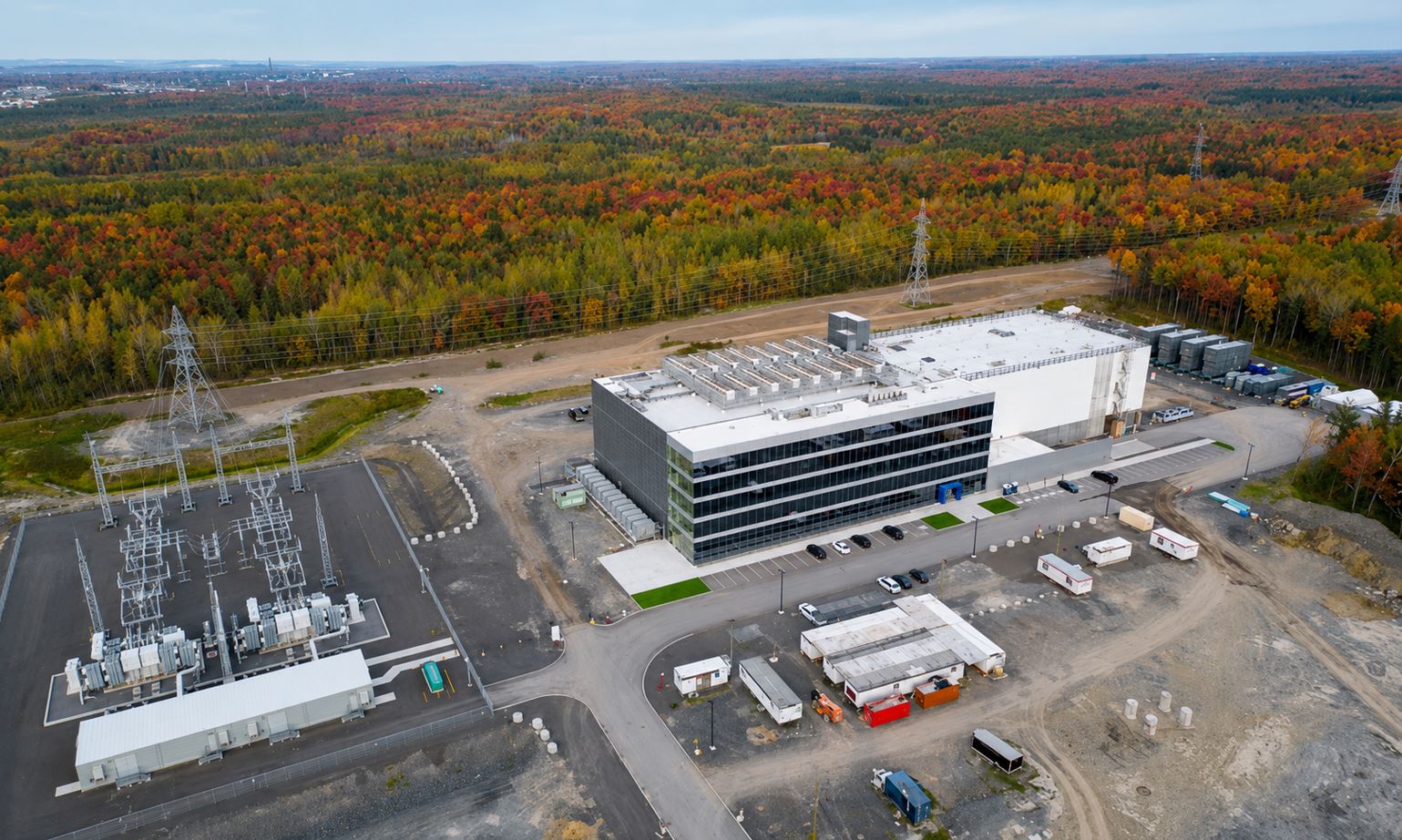 QScale’s Q01 Campus in Lévis, Quebec, shown during construction. Facilities like Q01 support Canada’s expanding AI infrastructure, but their reliability depends on the resilience of the interconnected critical infrastructure systems that support them.



Artificial intelligence (AI) is increasingly embedded in the systems that support economic activity, public services, and digital connectivity. Across Canada, governments and private companies are investing billions of dollars in the data centres and computing infrastructure needed to support future AI development. Projects such as QScale’s Q01 campus in Lévis, Quebec, reflect a broader effort to expand domestic AI capacity and reduce reliance on foreign-owned infrastructure.
Much of the current discussion surrounding AI infrastructure has focused on sovereignty, competitiveness, and national security. These are important considerations. However, they also raise a fundamental question: as Canada accelerates investment in domestic AI capacity, what risks may be overlooked in the rush to build? While debates continue over ownership, governance, and sovereignty, far less attention has been paid to the resilience of the physical infrastructure that powers AI systems amid increasingly frequent and costly extreme weather events.
Dependence on Foreign AI Infrastructure
AI is increasingly framed as a major economic opportunity tied to innovation, competitiveness, and the growth of a domestic technology sector capable of attracting investment, talent, and high-skilled employment. AI systems are also becoming more deeply embedded in critical public-sector and economic functions, from government services and infrastructure management to finance, logistics, and communications. Yet much of the current AI ecosystem still depends on advanced computing infrastructure located outside Canada.
Limited domestic AI capacity creates a deep dependency with implications for economic, security, and technological sovereignty. Without sufficient local infrastructure and expertise, governments, businesses, and institutions may increasingly rely on foreign-owned systems governed by external legal, regulatory, and commercial interests. Sensitive data may be subject to foreign jurisdictions, while organizations may have little choice but to adopt technologies shaped by the priorities and standards of other countries. Dependence on a small number of foreign AI providers also creates risks tied to infrastructure concentration, including disruptions caused by trade disputes, export controls, cyber incidents, or infrastructure failures abroad.
Reliance on external AI infrastructure also exposes domestic organizations to pricing volatility, compute limitations, and broader geopolitical uncertainty surrounding advanced technologies. As AI becomes increasingly dependent on compute-intensive systems, advanced computing capacity is becoming a strategic resource rather than simply a commercial service. Over time, dependence on a small number of dominant foreign platforms may also make it more difficult for domestic organizations and governments to shift toward Canadian alternatives in the future.
Canada’s Domestic AI Infrastructure Push
Canada’s AI strategy shifted significantly after 2021, moving from research support toward commercialisation, governance, and large-scale infrastructure investment. Budget 2021 committed $443.8 million to expand the Pan-Canadian Artificial Intelligence Strategy and strengthen domestic AI adoption through research and innovation programs. In 2022, Ottawa introduced Bill C-27, including the proposed Artificial Intelligence and Data Act (AIDA), Canada’s first attempt at national AI regulation, which ultimately failed to pass. By 2023 and 2024, the federal focus shifted toward AI governance and public infrastructure.
Since late 2024, Ottawa has increasingly framed AI as both a sovereignty and infrastructure issue. Budget 2024 marked a major turning point, announcing $2.4 billion in AI investments aimed at securing Canada’s long-term AI capacity and infrastructure footprint. Much of that funding focused on domestic compute infrastructure, including data centres and the Canadian Sovereign AI Compute Strategy.
Budget 2025 committed a further $925.6 million over five years to sovereign AI infrastructure initiatives, though $800 million of that figure was reallocated from the 2024 compute strategy rather than new money, bringing Canada’s net multi-year federal AI infrastructure commitment to roughly $2.5 billion. In May 2026, Minister of Artificial Intelligence and Digital Innovation Evan Solomon announced the first $66 million in AI Compute Access Fund support for 44 Canadian businesses, while acknowledging that demand for the program already exceeds available funding. Yet the rapid push to expand AI infrastructure has raised questions about whether speed and scale are beginning to outweigh other long-term policy priorities.
Compromises in the Rush to Build
Cohere, Canada’s leading AI company, became the first recipient of domestic AI infrastructure funding under the Sovereign AI Compute Strategy announced in Budget 2024. The funding helped secure long-term access to AI systems at a data centre in Cambridge, Ontario. However, the facility is being developed through a joint venture involving Ascent, a U.S.-based data centre company, Related Digital and TowerBrook Capital Partners, while the AI infrastructure itself is operated by CoreWeave, another U.S.-based company. The arrangement quickly raised questions about what “sovereign” AI infrastructure actually means in practice.
Federal officials defended the decision by pointing to the pace of global AI development and the need to secure infrastructure quickly. Similar concerns emerged during parliamentary hearings, where MPs questioned the implications of foreign ownership and data residency. Committee member Vincent Ho summarized the concern directly when he asked Industry Canada Associate Deputy Minister Mark Schaan: “How can you say it’s sovereign when a key piece of that supply chain is owned and operated by a U.S. company?”
Concerns surrounding U.S.-based infrastructure are partly tied to legislation such as the CLOUD Act, which can enable American authorities to access data held by U.S. companies, even when that data is stored abroad. While the practical implications depend on the nature of the data being stored and processed, the legislation has become a recurring point of debate in discussions surrounding data sovereignty and foreign-owned digital infrastructure.
These developments raise broader questions about how sovereignty is being defined and prioritized within Ottawa’s AI infrastructure strategy. If concerns surrounding ownership, foreign legal exposure, and data governance can be sidelined in the interest of rapid deployment, other long-term priorities may also risk being overlooked in the rush to build.
———
A Changing Climate Risk Landscape
In November 2021, a series of atmospheric rivers triggered catastrophic flooding across British Columbia’s Lower Mainland and Interior. Highways, rail corridors, electrical systems, and telecommunications services were affected as floodwaters inundated communities and cut off major routes across the province. The disaster caused hundreds of millions of dollars in insured losses, substantial recovery expenditures, and widespread disruptions to the flow of goods, services, and economic activity. While the 2021 floods were among the country’s most costly climate-related disasters, similar flooding again affected parts of British Columbia in 2025, underscoring the recurring nature of extreme weather risks.
These events are becoming increasingly difficult to dismiss as isolated incidents. The average cost of a disaster has risen from roughly $8 million in the early 1970s to more than $110 million today, while floods, wildfires, heat waves, and severe storms are increasing risks to transportation, energy, communications, and other critical infrastructure systems. The widespread wildfires currently affecting Northern Ontario demonstrate how climate hazards can strain interconnected infrastructure networks well beyond the immediate area of a disaster.
This changing risk landscape has important implications for the country’s AI ambitions. The data centres that support AI technologies are often discussed as digital infrastructure, but they are fundamentally physical assets vulnerable to many of the same climate-related hazards. They also depend on reliable access to supporting systems, including electricity, cooling, water, telecommunications networks, and transportation infrastructure.
Extreme weather can damage facilities directly, strain cooling systems during periods of extreme heat, interrupt water supplies, and disrupt the broader infrastructure networks that data centres depend on to remain operational. These risks are not hypothetical. A recent global assessment found that more than 7 percent of data centres in Canada are projected to face high physical climate risk by 2050. As Ottawa accelerates investment in domestic AI infrastructure, climate resilience must become part of the conversation surrounding long-term reliability, security, and sovereignty.
Resilience Must Be Part of the Conversation
Despite the growing risks posed by extreme weather, resilience remains largely absent from discussions surrounding AI infrastructure. Federal investments and policy initiatives have understandably focused on expanding compute capacity, strengthening sovereignty, and supporting economic growth. However, far less attention has been paid to how these facilities and the systems that support them will perform under increasingly challenging climate conditions.
Resilience refers to the ability to withstand, adapt to, and recover from disruption. For AI data centres, resilience can take many forms, from selecting sites with lower exposure to climate hazards to strengthening cooling, power, and communications systems. It can also involve incorporating redundancy into critical systems and designing facilities for future climate conditions rather than historical averages. These considerations are not separate from AI infrastructure planning; they are increasingly becoming a prerequisite for reliable operations.
Discussions surrounding domestic AI infrastructure have largely focused on competitiveness, security, and sovereignty. These are important priorities. Yet infrastructure that cannot withstand foreseeable disruptions cannot be considered truly secure. While current policy discussions have increasingly recognized the importance of clean energy and energy efficiency, adaptation requirements have received comparatively less attention. Ownership and location matter, but so too does the ability of critical systems to remain operational during periods of stress.
Canada is well positioned to benefit from the global expansion of AI. Access to clean electricity, a relatively cool climate, and growing public investment have created favourable conditions for future growth. However, the rapid push to expand domestic AI infrastructure should not allow resilience considerations to become an afterthought. As Ottawa continues to invest in AI capacity, resilience and adaptation should be treated as core design principles alongside reliability, security, and sovereignty. Climate risk assessments and resilience planning should become standard considerations in decisions related to the siting, design, and funding of future AI infrastructure.
Explore Topics
