

Lula Wins Yet Again
The Brazilian president comes from behind to defeat the Bolsonaro family.
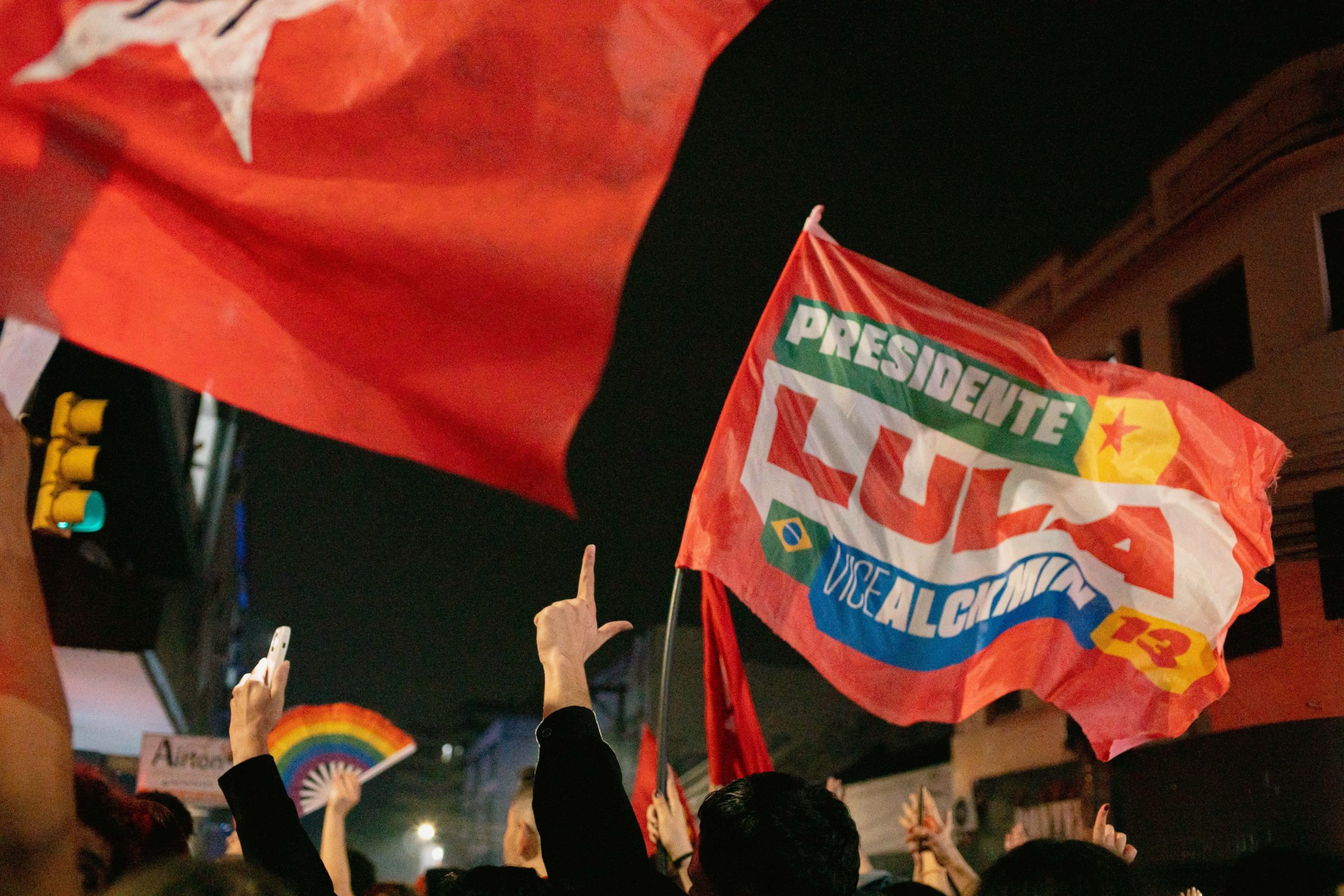 Supporters at a night rally waving flags with political slogans and hand signs.

President Lula of Brazil staged an unprecedented come-from-behind re-election, thus winning the presidency for a fourth time. This election reflected the polarization and negative partisanship of Brazilian politics. Even more than in his third term, Lula will face a hostile congress. More generally, the social changes in Brazil in recent decades have worked against the political left, and going forward the Workers’ Party (PT) will be challenged in a post-Lula world.
The Two Rounds
The 2026 Brazilian presidential election was a contest between left-wing incumbent President Luiz Inácio Lula da Silva, commonly known just as Lula, and populist right-wing Senator Flávio Bolsonaro, the son of Jair Bolsonaro who won the presidency in 2018 and then was defeated by Lula in 2022, after which he attempted a coup to stay in power and was convicted for plotting this. In December 2025, Jair Bolsonaro handpicked his eldest son Flávio as his successor. Brazil is a country with high political polarization and negative partisanship; that is, voters tend to vote against the opposite side (especially those on the centre-right voting against the Workers’ Party) rather than vote for something. Both candidates in 2026 were unpopular, with each having 45 percent of the population who would not vote for them under any circumstance. This led to what was called “apathetic polarization” during this campaign.
The first round was more of an anti-incumbent and thus anti-Lula vote, and Flávio Bolsonaro came out ahead 47.0 to 45.2 percent, better than the polls predicted and with clear momentum. Between the two rounds, though, Lula (or his supporters) turned things around in multiple ways: finally campaigning seriously on social media, having new popular (if unpaid for) policies, and turning the focus onto Bolsonaro (now the favourite), his scandals and associations, and his father’s conviction for plotting a coup to motivate voters against him and his potential presidency. This last strategy built on how pro-democratic attitudes led to voting for Lula over Jair Bolsonaro in 2022.
In terms of new policies, this included a new university student benefit, and both federal debt forgiveness and direct cash payments for registered microentrepreneurs. Priority for these cash payments would be given to women micro-entrepreneurs with lower revenue. These policies were campaign promises but only these; more amazingly, Lula also got the lame-duck Congress to pass a law shortening the work week with no change in pay. As a senator, Flávio Bolsonaro ended up voting for this law. Conversely, after the first round Senator Bolsonaro was overconfident, gave the impression of assuming victory and thus simply waiting for the clock to run out, and he made mistakes in the final television debate especially insulting Lula’s working class origins.
Thus, in the end, Lula won the run-off with 51.8 percent of the vote to 48.2 percent for Bolsonaro. In terms of the voters producing this switch, Lula gained the lead because of new voters (turnout went up between the rounds), because invalid votes and blank votes dropped as many of those first-round voters now voted in favour of him, because he did better than expected amongst the voters of the eliminated candidates (despite most of those endorsing Bolsonaro), and even seemingly because some first-round Bolsonaro voters switched to Lula in the second round. So did the state of Minas Gerais, preserving its bellwether status.
A Hostile Congress
Of course, the elections were not just for the presidency but also the Chamber of Deputies, two-thirds of the senate (Brazilian senators serve eight-year terms), the state governors, and the state legislatures. These generally did not involve (legislatures) or require due to majority victors (governors) run-offs and thus reflected the voting on 4 October 2026, which clearly leaned to the right. Indeed, nationally right-wing parties alone won a majority in the lower house (260 of the 513 seats in the Chamber of Deputies), with another 81 going to the centre-right. The centre and centre-left lost seats. In the Federal Senate the right will have a majority (48 of the 81 seats), though its gains came at the expense of the centre-right. In both chambers of the National Congress the Liberal Party of the Bolsonaro family will now be the largest force.
All of this will make it hard for President Lula to pass legislation, even harder than in his third term, unless he can pry off parts of the non-Liberal right. Regulation of social media is a likely early point of conflict. Moreover, there are major economic issues to deal with in terms of the budget deficit, national debt, and resulting high interest rates. However, Lula’s campaign, especially before the first round, was not really about new policies and laws but essentially about maintaining the status quo: defending democracy, protecting Brazil’s sovereignty, and preventing the Bolsonaro family’s return to power. And Lula will keep a foreign policy very different from the pro-Trump view of the Bolsonaro family. Additionally, there will be perhaps four (of eleven) supreme court vacancies for him to fill.
The Ending of a Larger-Than-Life Political Career
This presidential term will presumably end Lula’s decades-long political career in Brazil. Elected as a federal deputy in 1986, he first ran for president in 1989, making 2026 his seventh attempt. He was first elected president in 2002 and then re-elected in 2006. Presidential term limits in Brazil since 1997 are two consecutive terms in a row, but this limit is not for life as in the United States since 1951. Thus, a former president in Brazil who has served two consecutive terms can run for the presidency again after at least one full term has elapsed. After Lula’s first two terms as president, he chose his chief of staff (a cabinet position in Brazil) Dilma Rousseff as his successor. She was victorious in both the 2010 and 2014 presidential elections but was impeached in 2016 and succeeded by her vice president Michel Temer, who was an extremely unpopular president and did not run in 2018. Lula himself attempted to run for president again in the 2018 election, but his candidacy was rejected that August by the Superior Electoral Court (TSE) as he was in prison for corruption following from the Operation Car Wash probe. The former mayor of São Paulo Fernando Haddad, a close ally of Lula, was to have been his running mate but with Lula’s imprisonment wound up being the presidential candidate of the Workers’ Party, losing to Jair Bolsonaro in the PT’s only presidential defeat this century.
Three Electoral Eras
In terms of voting patterns, Brazilian presidential elections can be divided into three eras since 1989. In the first era, that of the 1989, 1994, and 1998 elections, Lula as the candidate of the Workers’ Party was continuously unsuccessful. Indeed, he lost in both 1994 and 1998 (to Fernando Henrique Cardoso) without even forcing a run-off vote. In the second era, that of the 2002, 2006, and 2010 elections, the situation was reversed. Lula won the first two of these elections decisively, as did his handpicked successor Rousseff in 2010 (albeit on the second ballot). Given that outgoing President Lula had an approval rating of 80 percent at the time of said election and supported her enthusiastically, Rousseff’s victory can be seen as an extension of his popularity, analogous to the United States in 1988 when George H.W. Bush won in what was in many ways a third victory for Ronald Reagan. Finally, the third era of the 2014, 2018, 2022, and now 2026 presidential elections has been the most competitive. Yes, the Workers’ Party candidate has won three of these elections, but never with more than 51.8 percent of the vote on the run-off. Indeed, across these four elections the PT candidate has received an average of 49.8 percent on the final ballot, in contrast to an average of 59.4 percent in the second era.
The broadening and then narrowing of the PT’s and Lula’s appeal can also be seen geographically. Of the 27 constituent federative units (areas) of Brazil (26 states and the federal district), Lula won only four areas in his first presidential election in 1989 and two in 1994 and 1998. He then won 26 (all but one) of these in his first victory in 2002; more generally, the PT candidate won an average of 21 (rounded) areas in the second era but only an average of thirteen areas (thus a minority) in the third era, including exactly thirteen in 2022 and now 2026. The PT’s base quickly became the poorer and more rural Northeast. Conversely, São Paulo state (the most populous and wealthiest per capita) has not voted for the Workers’ Party in a presidential election since 2002, despite Lula growing up and starting his union and political careers in the state. That said, Lula importantly clearly narrowed the gap there in the second round in 2026.
These changes, especially those of recent decades, reflect two major demographic shifts in Brazil. The first shift is in the nature of the urban economy and the labour force. The manufacturing industries in which Lula began his working life have declined due to deindustrialization, to be replaced by services and gig work. Consequently, the unionization rate fell from roughly a third of the labour force in the 1980s to under 10 percent by the early 2020s. That said, as noted above between the two rounds Lula targeted the now almost 14 million registered microentrepreneurs. The second shift is in religion, with evangelical Christians going from single digits in the 1980s to 27 percent of the population in 2022. These right-wing Pentecostal sects were central to support for the Bolsonaro family, whereas back in the 1970s and 1980s liberation theology and radical Catholic clerics were part of the rise of both unions and the Workers’ Party.
Looking Ahead to 2030
Going forward, in such a finely balanced polity, the 2030 Brazilian presidential election will hinge not just on the record of Lula’s fourth term but on the specific candidates. On the left Lula, who turned 81 on the Tuesday after the second round, needs to use the next four years to manage the transition to new leadership of the party he has dominated for so many decades, with that dominance having crowded out successors. And Lula’s vice-president, Geraldo Alckmin, is only a few years younger than him and has lost two presidential elections: in 2006 when he was the centre-right challenger to Lula, and in 2018 when he came a distant fourth in the first round. (Historically he was a long-time governor of São Paulo state.)
As with the distinction between MAGA and non-MAGA Republicans in the United States, the Brazilian right and centre-right can be divided between bolsonaristas and the more traditional right. And whereas a Bolsonaro made the runoff for president in the last three elections, Jair Bolsonaro is still serving a 27-year sentence for attempting to seize power in 2022, and Flávio Bolsonaro fled to the United States right after the election facing an investigation in a money-laundering case (with his senate seat and thus parliamentary immunity ending in the new year). While there are other Bolsonaro family members in politics (including now former First Lady Michelle Bolsonaro, who was elected a senator in 2026 and who has a strong profile amongst religious voters), a more traditional conservative with less baggage would presumably be more electable (if less charismatic). The standard name here is Tarcísio de Freitas, a minister under Jair Bolsonaro who won re-election as governor of São Paulo state in a landslide (62.7 percent of the vote on the first ballot) over Fernando Haddad of the PT. Given that 2026 was more of a defeat of Bolsonarismo than a victory for Lula (who in any case will not be running in 2030), the main right-wing candidate then will be a central issue.
