

The Cost of Dependence
What Canada’s GlobalEye Decision Reveals About Defence in the Trump Era.
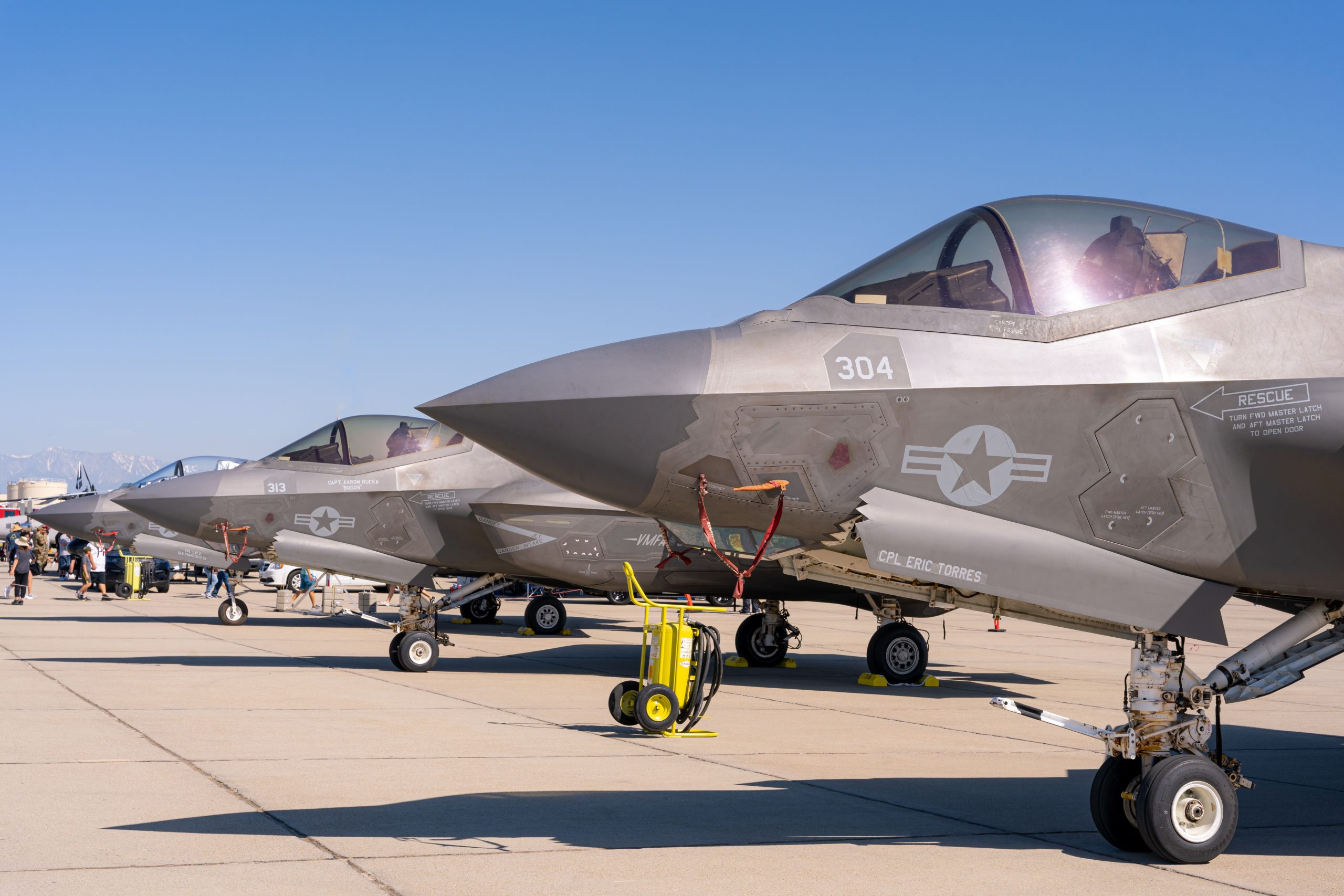 F-35 fighter aircraft on display. The debate over Canada's future fighter fleet reflects broader questions about defence procurement and strategic dependence in an uncertain geopolitical environment.

The most striking feature of Prime Minister Carney’s May 27 announcement that Canada was negotiating to acquire the Swedish firm Saab’s GlobalEye airborne early warning and control aircraft platform is that it appeared to end consideration of a competing surveillance aircraft produced by the US manufacturer Boeing. But the announcement is illustrative of a broader emerging trend in the defence policies of not only Canada but other NATO allies.
Procurement Is Never Just Procurement
As Clausewitz famously observed, war is the continuation of politics by other means, and decisions to prepare for war and procure the necessary weaponry are also political. To be sure, defence procurement decisions should rest primarily on considerations of military utility. But these decisions are also inevitably political. They flow from broader policy and strategy. They shape a state’s dependence upon, and ability to resist pressure from, allies, the degree of influence it can exercise within alliances, and its freedom to pursue independent policies and strategies. In addition, large-scale weapons purchases can loom large in overall trade relations between states.
A few weeks ago, a retired foreign service officer told me over lunch that he thought Carney was delaying a decision on the purchase of US F-35s as leverage in the upcoming CUSMA renegotiations (conceivable, though President Trump’s ingratitude for concessions and record of violating deals to which he has agreed suggest such a strategy wouldn’t be productive). In his January speech at Davos, Carney warned against the weaponization of interdependence. The Trump administration’s willingness to weaponize allied dependence on the United States is the context in which US allies are adjusting their defence postures.
NATO’s other members have long assumed they would provide niche capabilities to a US-dominated coalition in any war. They lack the capacity to deploy and coordinate large forces for protracted conflict, depend upon the United States for core capabilities such as heavy airlift, long-range striking power, and Intelligence, Surveillance, and Reconnaissance (ISR), and are now subject to the caprices of a US President who has demonstrated at best lukewarm commitment to the alliance, and has obstructed its efforts to help Ukraine resist aggression.
As the US has become increasingly unreliable, they have begun creating defensive arrangements that bypass it: Germany and the Netherlands are setting up a joint command centre in the Baltics to shore up NATO’s Eastern flank; Britain and France are increasing coordination of their nuclear deterrents; and Canada has been selected to host a multilateral “bank” to help finance joint defence purchases. As for procurement, Canada is considering joining a German-Norwegian consortium to replace its aging Victoria-class submarine with a vessel optimized for protracted operations in Northern waters.
Why GlobalEye Matters
But the GlobalEye announcement has several distinctive features. One is that Saab has promoted GlobalEye as part of a package deal in which the surveillance aircraft would complement the Gripen fighter jet, under consideration for purchase as partial successor to the CF-18 fighter, though Ottawa is reviewing a planned purchase of 88 US-made F-35s, which would be reduced if the Gripen were acquired as part of a “mixed fleet” (Canada has already committed to buy 16 F-35s). Negotiations over GlobalEye will not necessarily lead to purchase, much less to purchase of Gripen fighters as well, but the two aircraft are complementary. GlobalEye’s sensors provide long-range surveillance ideal for the Canadian Arctic, while the Gripen can intercept the hostile objects GlobalEye tracks.
Another feature of the GlobalEye announcement, as of a potential Gripen purchase, is that it would be used by the Canadian military not only in NATO but within NORAD, the unique Canada-US binational command tasked with continental defence. The shared geography dictates a high degree of military integration and interoperability for seamless defence of the shared landmass. After the Justin Trudeau government initiated a review of the F-35 purchase in response to ballooning costs, a leaked document from within the Department of National Defence (where a preference for US weaponry is strong) ranked the US fighter as far superior to the Gripen, and argued that a mixed fleet would complicate interoperability with the US.
Yet there are reasons for skepticism. The F-35’s principal advantage is its stealth capacity, which has driven rising costs and is a wasting asset over the craft’s 50-year life cycle, as adversaries improve their ability to detect and target stealth aircraft. Moreover, stealth aircraft can already be detected by some long-wave ground-based radar and have a reduced payload because they require only internal weapon bays. The Gripen has greater sustained speed, superior payload capacity, half the unit cost, and can be based and maintained at remote Arctic bases with short runways. The relative superiority of weapon systems is a function of specific missions. The F-35 is superior in ways that are ideal for some roles, such as offensive operations in defended airspace which Canada might undertake within NATO, where its stealth capability would, for the next few years, be important. But its advantages are superfluous to Arctic surveillance and interdiction missions, for which the Gripen is ideal.
A mixed fleet with Gripens based in the north and tasked with surveillance and interdiction, while the F-35s were based further south and ready for reconnaissance and strike missions as a fighter-bomber would meet Canadian needs. Many of our allies have mixed fleets, and for much of the Cold War Canada had them. Indeed, mixed fleets with different aircraft for different missions are more logical than using one craft for every role. As for interoperability, after Sweden joined NATO in 2024, Saab acquired the data to integrate the Gripen’s software to NATO requirements, and any additional modifications required for NORAD could be made in Canada, since we would have access to the software source codes and could alter them as necessary.
The Cost of Dependence
To be sure, there are costs to a mixed fleet: two supply chains; two sets of crews requiring different training; additional administrative and maintenance arrangements; and certain sunk costs. But in this case, there are important benefits. GlobalEye production in Canada would be through Bombardier, whose 6500 airframe would be used, and Gripen production would also use Canadian manufacturing and support facilities, substantially strengthening Canada’s defence industrial base. It would also help Sweden’s military aircraft sector, building on the recent sale of Gripens to Ukraine to develop a NATO-compatible Ukrainian air force. Canada and NATO’s European members must cooperate more to defend their territories and waters and be willing to jointly invest more in the production of the arms that underpin shared defence.
A troubling fact is that officials within the Trump administration have said dropping the F-35 in favour of Gripens might lead to a refusal to provide access to the encryption system allowing Gripens and F-35s to communicate and perhaps changes to NORAD. But concessions to Washington would not eliminate vulnerability to US pressure, since US control of the F-35 supply chain would allow withholding upgrades should Ottawa incur the administration’s displeasure.
Such threats strengthen the case for reduced military interdependence with the United States by demonstrating the current administrations’ eagerness to use it to extort commercial favours or express political displeasure. Interdependence in military hardware is safe and justifiable to the extent that it rests on mutual trust and reliability, as well as broad agreement on policy and strategy. These can no longer be taken for granted in Canadian dealings with the United States. Canadian interdependence with the United States in NATO and, to a greater extent, NORAD, is largely inevitable. But within the broader political context in which procurement decisions are taken, it is prudent to seek interdependence with those we can trust not to abuse it and reduce our vulnerability to pressure from those we can’t. Carney’s announcement on GlobalEye was a sensible decision, and committing to a mixed fleet would be yet another. Clausewitz would approve.
